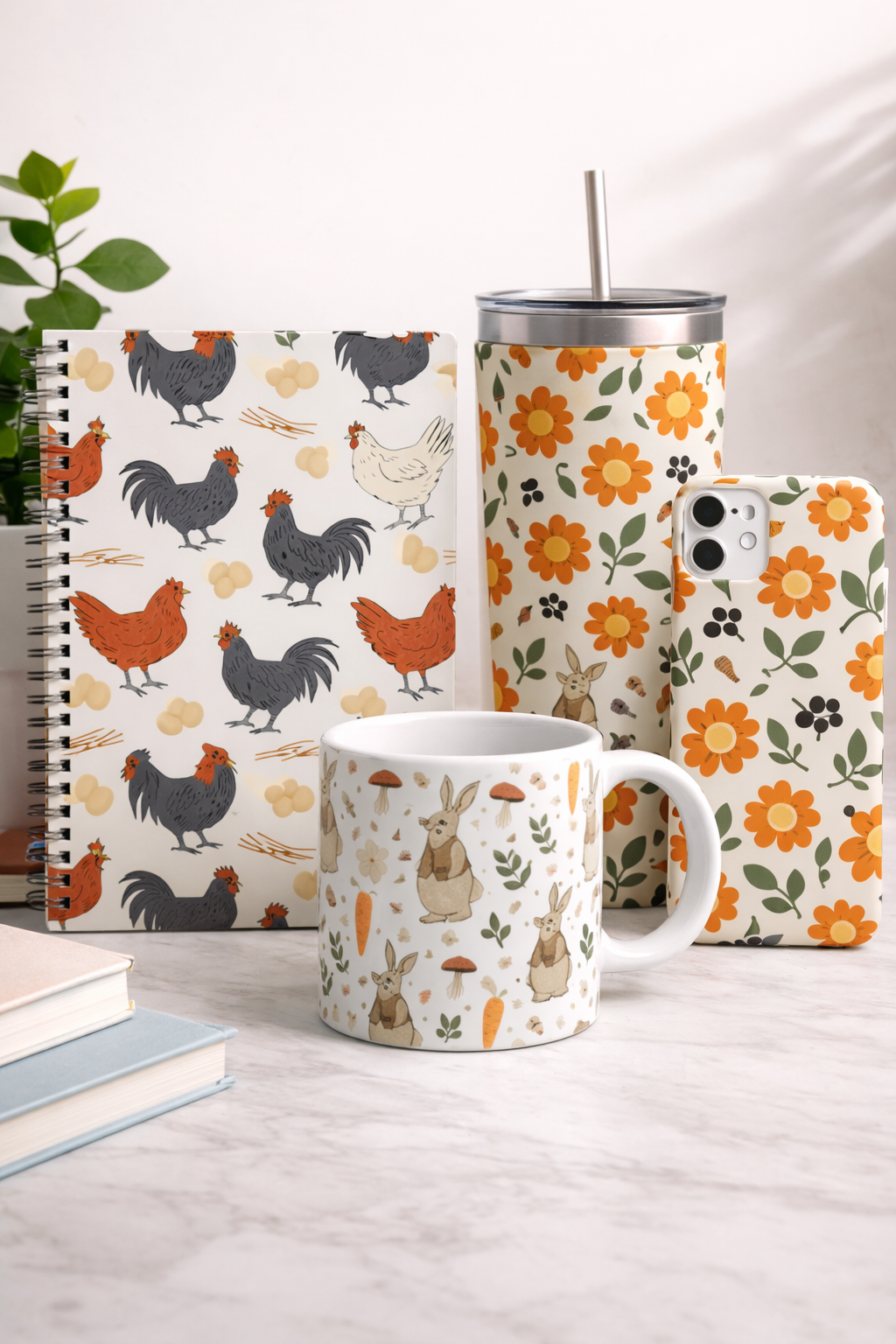
What Is a Seamless Pattern and Why Designers Use Them
If you’ve ever seen a piece of fabric, wrapping paper, wallpaper, or packaging that seems to repeat forever without obvious edges, you’ve encountered a seamless pattern. Seamless patterns are a core part of surface design, quietly shaping the visual world around us. From clothing and home décor to notebooks and product packaging, these repeating designs are everywhere once you start noticing them.
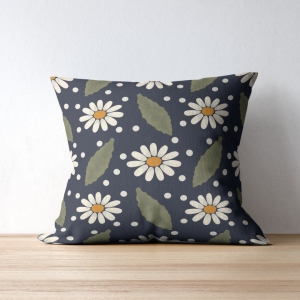
A seamless pattern is a design that repeats perfectly on all sides without visible breaks or mismatched edges. When the tile repeats horizontally or vertically, the pattern flows continuously. This means a single square of artwork can be repeated infinitely to cover surfaces of any size. The illusion is simple but powerful: the design feels endless.
The reason seamless patterns are so widely used is efficiency. Instead of creating an entirely new design for every product surface, a designer can create one repeat tile that works across many formats.
That tile can be scaled, recolored, or adjusted while maintaining its repeating structure. In practice, that means one pattern might appear on fabric, packaging, stationery, and home goods all within the same collection.
Seamless patterns are especially important for industries that rely on consistent visual design. Textile companies use them to create fabric prints for clothing and upholstery. Product companies use them for packaging and branding elements. Stationery brands use them for journals, wrapping paper, and gift bags. Even digital design frequently incorporates repeating patterns for backgrounds and web graphics.
Another advantage of seamless patterns is versatility. Because the design repeats evenly, it adapts easily to different product shapes and sizes. A pattern might look delicate and minimal on a notebook cover, but when scaled up, it can become bold and decorative on wallpaper. Designers can adjust the size of the repeat or the density of motifs to suit different applications.
The structure of a seamless pattern also allows for creative storytelling. Many patterns begin with small motifs such as flowers, leaves, animals, symbols, or geometric elements. These motifs are arranged inside a repeating tile so that when the tile is duplicated, the pattern appears continuous. The process requires both artistic intuition and technical understanding of how repeats function.
Surface designers often think in terms of collections rather than single patterns. A pattern collection might include a main design filled with detailed motifs, a secondary pattern that supports the overall theme, and simpler coordinating designs called blenders. Together, these patterns create visual cohesion across a range of products.
For small businesses and product makers, seamless patterns are an accessible way to add visual depth to products without hiring a full-time designer. A repeat pattern can be applied to product packaging, fabric, stickers, notebooks, labels, or even website graphics. Because the design repeats automatically, it scales easily to fit many different surfaces.
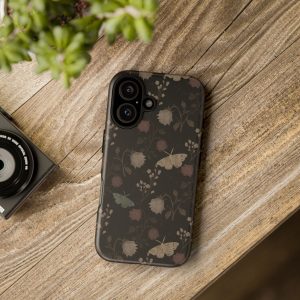
In recent years, seamless patterns have also become widely used in print-on-demand products. Sellers on platforms like Etsy, Spoonflower, and other product marketplaces rely on repeat designs to decorate items such as fabric, blankets, tote bags, phone cases, and stationery. A single pattern can be applied to dozens of products.
The rise of digital design tools has made seamless patterns more accessible than ever. Artists now create patterns using both traditional sketching methods and digital illustration software. The process often begins with hand-drawn motifs that are then arranged into a repeat structure. Once the pattern tile is finalized, it becomes a flexible design asset that can be used across many product formats.
At Spore & Sigil, the philosophy behind the patterns is rooted in intentional design. The name itself reflects that idea: spores represent growth and organic spread, while sigils represent mark-making and meaning. The patterns are built with the idea that even repeating designs can carry a sense of story and atmosphere.
Whether inspired by nature, symbolism, or everyday textures, each pattern begins as a collection of small drawings. Those drawings are arranged into repeat structures that allow them to expand outward across any surface. The result is a design that feels both structured and organic.
Once you begin recognizing seamless patterns in the world around you, you’ll see them everywhere. They are on clothing, furniture, fabrics, product packaging, and even in digital spaces. What appears to be a simple decorative surface is often the result of careful design decisions and thoughtful repetition.